
Quick Answer
By Legal Brigade, Property Law Specialist | Bar Council of Karnataka | Legal Brigade A Khata is BBMP’s official record of a property’s ownership for tax assessment purposes in Bangalore. It is the entry in BBMP’s property register that confirms who is liable for property tax and whether the property is legally recognized.
By Legal Brigade, Property Law Specialist | Bar Council of Karnataka | Legal Brigade
A Khata is BBMP’s official record of a property’s ownership for tax assessment purposes in Bangalore. It is the entry in BBMP’s property register that confirms who is liable for property tax and whether the property is legally recognized. A-Khata and B-Khata are the two classifications, and A-Khata is the only one that gives full legal standing.
What Is a Khata and What Does It Record?
A Khata is the official property entry maintained by the Bruhat Bengaluru Mahanagara Palike (BBMP) for every property within its jurisdiction. It records the owner’s name, the property’s exact location, its dimensions, the type of construction, and the property tax assessment details. The Khata is not the title deed itself, but it is the municipal authority’s official recognition that the property exists in its records and that taxes are being assessed against it.
Without a valid Khata, a property owner cannot pay property tax formally, cannot obtain a building plan sanction, cannot apply for a trade license, and cannot transfer the property through a registered sale deed in many cases. The Khata is therefore the bridge between private ownership (proved by the sale deed) and public municipal recognition (proved by the Khata entry). In Bangalore, the Khata system was introduced after the BBMP was formed in 2007 to unify property tax collection across the city, which previously had three different bodies managing tax records.
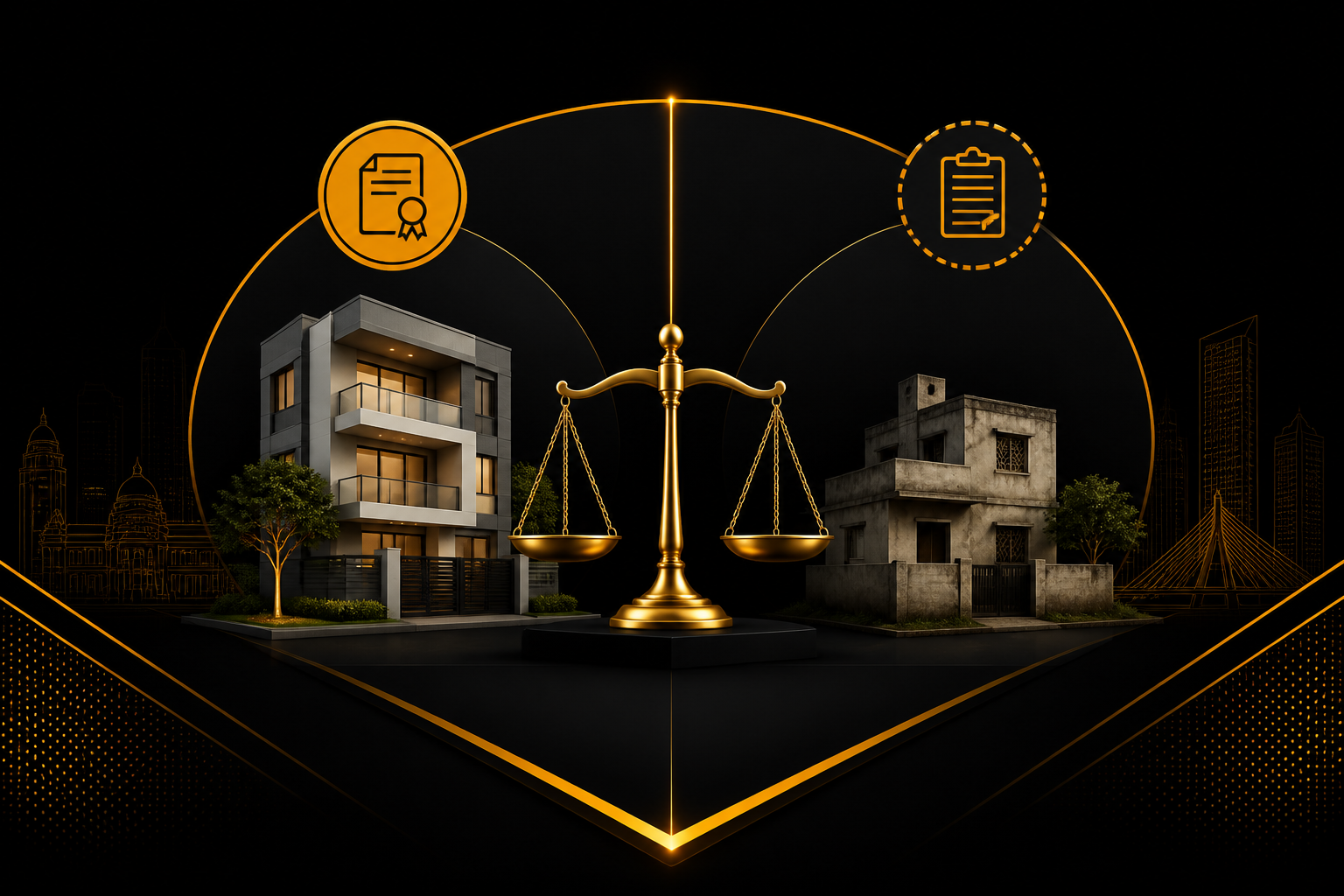
What Is the Difference Between A-Khata and B-Khata in Bangalore?
Feature | A-Khata | B-Khata |
|---|---|---|
BBMP recognition | Fully recognized in the official A-register | Listed in the separate B-register as a temporary entry |
Building plan eligibility | Eligible for building plan sanction from BBMP | Not eligible for sanctioned building plans |
Home loan availability | Major banks readily approve home loans | Most banks routinely refuse home loans for B-Khata properties |
Resale market | Higher demand and easier resale | Lower demand; buyers are cautious |
What it means about the property | Property is fully compliant with zoning, conversion, and tax laws | Property has one or more compliance gaps (missing DC conversion, unauthorized construction, layout not approved, tax arrears, or gram panchayat origin not yet regularized) |
Can it be upgraded | Already at the highest status | Can be converted to A-Khata if compliance gaps are cured |
Typical reason for B-Khata status | Not applicable — property is fully compliant | Missing DC conversion, unauthorized construction, unapproved layout, property tax arrears, or gram panchayat origin |
The Karnataka High Court, in its December 2014 ruling, nullified whatever limited legal status B-Khata properties previously enjoyed. As of now, B-Khata properties are categorized as illegal or semi-legal properties and must be converted to A-Khata to avoid complications in trading, construction, and transferring of the property. The 2014 ruling fundamentally changed the risk profile of B-Khata ownership in Bangalore.
Why Does B-Khata Make a Property Harder to Sell or Finance?
B-Khata status creates a cascade of practical problems for property owners. Major banks and housing finance companies routinely refuse home loans for B-Khata properties because the collateral is not legally secure. This means a buyer who needs financing simply cannot purchase a B-Khata property through normal banking channels, which eliminates a large portion of the potential buyer pool.
Even for cash buyers, B-Khata creates hesitation. A buyer who purchases a B-Khata property inherits the compliance gaps. They may need to spend significant money on DC conversion, betterment charges, and regularization fees to upgrade to A-Khata. The resale value of B-Khata properties is therefore typically lower than comparable A-Khata properties. Furthermore, building plan sanction is not available for B-Khata properties, which means the owner cannot legally construct, renovate, or expand. This limits the property’s utility and future value.
What Are the Common Reasons a Property Gets B-Khata Status?
- Missing DC conversion: The land was originally agricultural and was never officially converted to non-agricultural use by the Deputy Commissioner. Without DC conversion, the property cannot be regularized.
- Unauthorized construction: The building was constructed without a sanctioned building plan or deviated significantly from an approved plan. BBMP flags such properties as non-compliant.
- Layout not approved by planning authority: The property is part of a layout that was never approved by BDA, BMRDA, or the relevant planning authority. Unapproved layouts are a common source of B-Khata status.
- Property tax arrears: The previous owner failed to pay property taxes for an extended period. BBMP may downgrade the Khata status until all dues are cleared.
- Gram panchayat origin not yet regularized: The property was originally under a gram panchayat before being absorbed into BBMP jurisdiction. If the regularization process was not completed, the property may carry B-Khata status.
How Do I Check My Property’s Khata Status in Bangalore?
- Go to the BBMP property tax portal: Access the official BBMP e-Aasthi or property tax portal online. The portal allows property owners and prospective buyers to search property details using the Property Identification Number (PID) or assessment number.
- Enter the PID or application number: Every property in BBMP jurisdiction has a unique PID. Enter this number in the search field. If you do not know the PID, you can search using the ward number, street name, or assessment number.
- View the property details and Khata type: The portal will display the property’s tax details, owner name, and critically, whether the property is classified as A-Khata or B-Khata. Note the Khata certificate number if available.
- Cross-check against the physical Khata certificate held by the seller: Ask the seller to produce the physical Khata certificate or extract. Compare the details on the certificate with the portal records. Any mismatch in name, survey number, or extent is a red flag.
- For any discrepancy, visit the relevant BBMP ward office directly: If the portal shows a different status than what the seller claims, or if the property is not found on the portal, visit the jurisdictional BBMP ward office or Assistant Revenue Officer (ARO) with the property details. The revenue section can provide the official Khata status and explain any discrepancies.
What Is E-Khata and Is It the Same as a Regular Khata?
E-Khata is the electronic version of the Khata certificate issued by BBMP through its online portal. It carries the same legal validity as a physical Khata certificate. BBMP has been pushing for e-Khata adoption to reduce fraud, streamline transfers, and create a centralized digital record.
From 2025, e-Khata has become increasingly mandatory for property registration in Bangalore. The e-Khata system links the property to the owner’s Aadhaar through eKYC, which reduces name-mismatch fraud. To verify the genuineness of an e-Khata, check that the certificate has a valid QR code or digital signature, cross-reference the ePID on the BBMP portal, and confirm that the eKYC status shows as completed.
See Legal Brigade’s guide to e-Khata fraud at /e-khata-fraud-bangalore/
How Do I Transfer Khata After Buying Property in Bangalore?
Step | Action | Documents Needed | Timeline |
|---|---|---|---|
Application submission | Submit the Khata transfer application at the BBMP ward office or through the e-Aasthi portal | Registered sale deed, previous Khata certificate, property tax receipts, ID proof of new owner | Day 1 |
Supporting documents | Upload or submit all supporting documents including the registered sale deed, previous Khata, and tax clearance receipts | Sale deed (registered), previous Khata certificate/extract, latest property tax paid receipts, ID and address proof of new owner, passport-size photographs | Day 1-3 |
Fee payment | Pay the Khata transfer fee and any outstanding property tax dues | Fee receipt, tax clearance proof | Day 3-7 |
Verification | BBMP revenue inspector conducts field verification and document scrutiny | Physical site may be inspected; be prepared to show the property boundary | Day 7-20 |
Certificate issuance | BBMP issues the new Khata certificate in the buyer’s name | New Khata certificate or e-Khata download | Day 20-45 |
The Khata transfer should be applied for immediately after property registration. Delaying the transfer means property tax bills continue to go to the previous owner’s name, which creates complications when you later need to prove tax payment for building plan sanction or resale.
Can B-Khata Be Converted to A-Khata in Bangalore?
Yes, B-Khata can be converted to A-Khata if the underlying compliance gaps are cured. The process involves clearing all property tax dues, obtaining any missing approvals (such as DC conversion for agricultural land), paying betterment charges, and submitting the conversion application to BBMP.
The Karnataka government launched the “Bhu Guarantee” / “Nanna e-Khata, Nanna Hakku” drive in May 2026, which reduced the B-to-A conversion fee from 5% to 2% of the property’s guidance value for a 100-day window (May 15, 2026 to August 23, 2026). After this window, the fee reverts to 5%. BBMP also hosts E-Khata Open House camps every Saturday at 52 venues across Bengaluru for on-the-spot assistance.
However, not all B-Khata properties can be converted. If the property is on land that cannot be DC-converted (such as certain government grant land), or if the violations are severe (such as construction in a lake buffer zone), conversion may not be possible. A property lawyer should assess the specific property before the buyer assumes conversion is feasible.
See Legal Brigade’s full guide on B-Khata property risks at /is-it-safe-to-buy-b-khata-property/
Frequently Asked Questions About Khata in Bangalore
Q1. What is a Khata in Bangalore property?
A Khata is the official property record maintained by BBMP that identifies the owner for tax assessment purposes. It is not the title deed, but it is essential for paying property tax, obtaining building plan sanctions, applying for trade licenses, and transferring property. Every property in BBMP jurisdiction should have a Khata entry, classified as either A-Khata or B-Khata.
Q2. What is the difference between A-Khata and B-Khata?
A-Khata means the property is fully compliant with BBMP regulations, zoning laws, and tax requirements. The property is in the official A-register. B-Khata means the property has compliance gaps — such as missing DC conversion, unauthorized construction, or unapproved layout — and is listed in the separate B-register. A-Khata properties can get bank loans, building sanctions, and trade licenses. B-Khata properties generally cannot.
Q3. Can I get a home loan for a B-Khata property in Bangalore?
Most major banks and housing finance companies refuse home loans for B-Khata properties because the collateral is not legally secure. Some private lenders may offer loans at higher interest rates with stricter conditions, but government banks typically do not lend against B-Khata properties. This is one of the most significant practical disadvantages of B-Khata status.
Q4. Is it safe to buy a B-Khata property?
Buying a B-Khata property carries legal and financial risks. The property is classified as semi-legal or illegal since the 2014 Karnataka High Court ruling. You may not be able to get a home loan, obtain a building plan sanction, or resell easily. If the property can be converted to A-Khata, the risk may be manageable, but conversion is not guaranteed for all properties. Always get a property lawyer to assess whether conversion is feasible before buying.
Q5. How do I check a property’s Khata status online?
Visit the BBMP property tax portal or e-Aasthi portal. Enter the Property Identification Number (PID) or assessment number. The portal will display the property details including the Khata type (A or B). Cross-check this with the physical Khata certificate provided by the seller. If there is any discrepancy, visit the BBMP ward office directly for clarification.
Q6. What is an E-Khata and how is it different from a regular Khata?
E-Khata is the electronic version of the Khata certificate issued through BBMP’s online portal. It has the same legal validity as a physical Khata certificate. E-Khata is linked to the owner’s Aadhaar through eKYC, which makes it harder to forge. From 2025, e-Khata is increasingly mandatory for property registration in Bangalore. The main difference is the digital format and the Aadhaar-linked verification.
Q7. How do I transfer the Khata to my name after buying property?
Apply for Khata transfer at the BBMP ward office or through the e-Aasthi portal immediately after registration. Submit the registered sale deed, previous Khata certificate, latest property tax receipts, your ID proof, and photographs. Pay the transfer fee. BBMP will conduct a verification and issue the new Khata certificate in your name within 20 to 45 days.
Q8. Can B-Khata be converted to A-Khata in Bangalore?
Yes, if the underlying compliance gaps are cured. This typically involves clearing tax dues, obtaining missing DC conversion, paying betterment charges, and submitting a conversion application. The Karnataka government’s 2026 “Bhu Guarantee” drive temporarily reduced the conversion fee from 5% to 2% of the guidance value. However, some properties cannot be converted due to severe violations or land-use restrictions. A lawyer should assess the specific property first.
Q9. What is a Khata certificate and what does it contain?
A Khata certificate is the official document issued by BBMP confirming the property’s entry in the municipal register. It contains the property owner’s name, the property’s address and survey number, the dimensions and type of construction, the property tax assessment details, and the Khata number. For e-Khata, the certificate is downloaded from the BBMP portal and includes a digital signature or QR code for verification.
Q10. Why do banks refuse home loans for B-Khata properties?
Banks refuse home loans for B-Khata properties because the property is classified as semi-legal or illegal under the 2014 Karnataka High Court ruling. The collateral is not legally secure. If the borrower defaults, the bank may not be able to enforce the mortgage or sell the property to recover the loan. B-Khata properties also have restricted transferability and lower resale value, which increases the bank’s risk. This is an established practice across major banks in Bangalore.
Buying a property in Bangalore and unsure about its Khata status?
Legal Brigade verifies Khata as part of every property check — we confirm A-Khata vs B-Khata, check the e-Khata genuineness, and assess whether B-Khata conversion is feasible before you commit.
WhatsApp → wa.me/916360266840
Frequently Asked Questions
What is the difference between A-Khata and B-Khata in Bangalore? ▾
A-Khata properties are fully recognized by BBMP and compliant with all zoning and tax laws, allowing for building sanctions and home loans. B-Khata properties have compliance gaps like missing DC conversion or unauthorized construction and are stored in a separate temporary register.
Can I get a home loan for a B-Khata property? ▾
Most major banks and housing finance companies refuse home loans for B-Khata properties because the collateral is not legally secure. This significantly limits the buyer pool and resale value of such properties compared to A-Khata counterparts.
How can I verify a property's Khata status online? ▾
You can visit the official BBMP e-Aasthi or property tax portal and search using the Property Identification Number (PID). The portal will display the owner's name, tax details, and whether the record is classified as A-Khata or B-Khata.
What is an E-Khata and why is it important? ▾
E-Khata is the digital version of the Khata certificate issued by BBMP, linked to the owner's Aadhaar via eKYC to prevent fraud. As of 2025, it has become increasingly mandatory for property registrations in Bangalore to ensure a centralized digital record.
Need a property document review in Bangalore?
Talk to Legal Brigade. We respond within 5 minutes.
Book a consultation →