
Quick Answer
What Legal Checks Are Needed When an Apartment Building’s Side or Rear Boundary Setbacks Were Reduced Without a Plan Amendment in Bangalore? By the Property Law Team | Legal Brigade | Bar Council of Karnataka When a Bangalore apartment building was physically constructed with smaller setbacks on the side or rear boundaries of the plot…
What Legal Checks Are Needed When an Apartment Building’s Side or Rear Boundary Setbacks Were Reduced Without a Plan Amendment in Bangalore?
By the Property Law Team | Legal Brigade | Bar Council of Karnataka
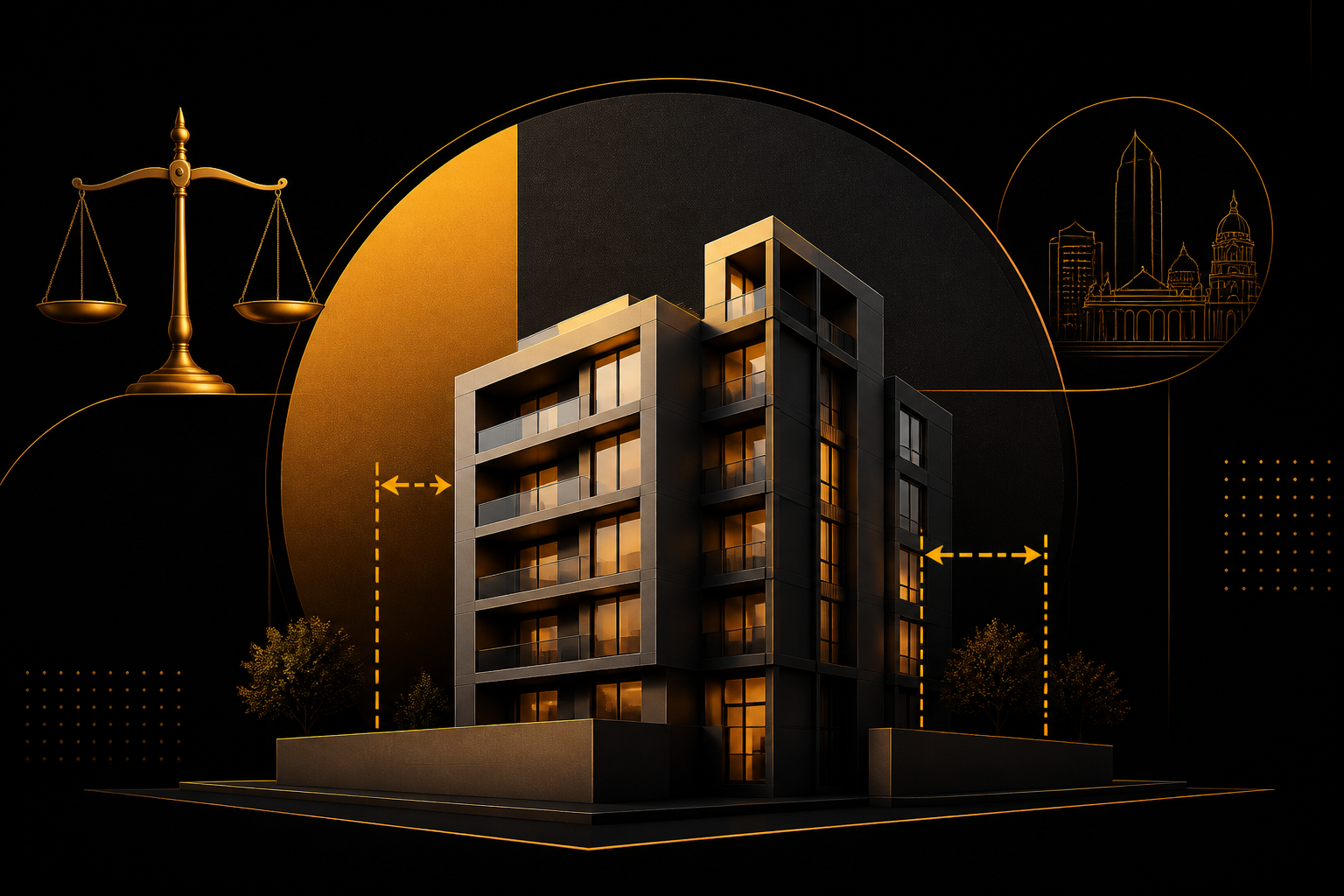
When a Bangalore apartment building was physically constructed with smaller setbacks on the side or rear boundaries of the plot than the BBMP-sanctioned building plan specified for the building’s plot size and height – either because the developer reduced the setbacks to gain additional floor plate area on the interior floors, because the construction misaligned relative to the plot boundary or because the building’s stairwells, shafts or service structures were positioned closer to the side or rear boundary than the sanctioned plan showed – the reduced setbacks are building plan deviations that BBMP can enforce through a compounding or demolition notice and that the adjacent property owners can separately enforce through civil suits for nuisance, reduced light and ventilation or the direct trespass of structures into their property’s setback zone.
What Are Side and Rear Setbacks and Why Are They Specifically Required?
While the road setback (covered in Page 517) protects the building’s relationship with the public road, the side and rear setbacks protect the relationship between the building and adjacent private properties. BBMP’s building regulations specify minimum side setbacks – the distance from the building’s side wall to the side plot boundary – and rear setbacks – the distance from the building’s rear wall to the rear plot boundary. These setbacks serve to: ensure natural light and ventilation reach all sides of the building and its neighbours; prevent buildings from being so close to adjacent buildings that fire can spread rapidly between them; provide access for maintenance of the building’s exterior from all sides; and prevent the building from physically encroaching on adjacent properties or their required setbacks.
The side and rear setback requirements increase with the building’s height – a taller building must maintain greater setbacks to ensure its height does not block disproportionate light from adjacent properties. A 10-storey apartment building must maintain a larger side setback than a 3-storey building on the same plot. When a developer reduces the side or rear setbacks from what the plan specifies, the reduced setbacks may leave adjacent property owners with reduced natural light and ventilation – a nuisance that gives the adjacent owners a civil remedy in addition to BBMP’s regulatory enforcement.
Table 1: Side and Rear Setback Deviation Consequences
Deviation Type | Affected Parties | BBMP’s Remedy | Adjacent Owner’s Remedy |
|---|---|---|---|
Side setback reduced – building wall closer to adjacent plot than plan specifies | Adjacent plot owner loses light and ventilation – and has reduced setback to their own building if they develop | BBMP compounding or demolition notice for the encroaching portion | Civil suit for nuisance (reduced light and ventilation) or mandatory injunction for demolition if the deviation is severe |
Side wall actually crosses the boundary – into adjacent property | Adjacent property owner faces actual encroachment on their land | BBMP demolition notice – the encroachment is both a plan deviation and a trespass | Civil suit for trespass – adjacent owner can demand demolition of the encroaching portion |
Rear setback reduced – building rear wall closer to rear boundary than plan specifies | Rear neighbour loses light and ventilation from the rear | BBMP compounding or demolition notice | Civil suit for nuisance if the deviation is material |
Service structures – water tanks, stairwells – placed in the setback zone | The setback’s usable open space is occupied by structures | BBMP compounding for the structures in the setback zone | Adjacent owner may seek removal if the structures create a nuisance or block light |
How Do Side and Rear Setback Deviations Differ From the Road Setback?
The road setback deviation (Page 517) is primarily a BBMP enforcement issue – BBMP enforces the road setback because it affects the public road’s character and emergency vehicle access. Adjacent private property owners have a less direct stake in the road setback. The side and rear setback deviations are both a BBMP enforcement issue and an adjacent owner’s private nuisance issue – the adjacent property owner’s light, ventilation and development rights are directly affected by the side and rear setback reductions.
This dual enforcement mechanism makes side and rear setback violations potentially more serious for building owners than road setback violations. A road setback violation that is compounded with BBMP leaves the building relatively secure against further enforcement. A side or rear setback violation that is compounded with BBMP may still leave the adjacent owner with a civil nuisance claim – because BBMP’s compounding does not extinguish the adjacent owner’s private law rights.
How Do I Check the Side and Rear Setback Compliance Before Buying?
Step 1: Obtain the BBMP-sanctioned building plan and note the required side and rear setback dimensions specified in the plan – expressed as distances from the building’s walls to the respective plot boundaries.
Step 2: Physically measure the side and rear setbacks during the site visit – from the building’s side and rear walls to the visible plot boundary markers, walls or fences. Compare these measurements against the plan dimensions.
Step 3: Look specifically at the relationship between the building’s side wall and the adjacent building or boundary wall. A gap of less than the plan’s specified setback between the building and the adjacent boundary is a setback deviation.
Step 4: Ask the developer or association whether any complaint has been received from adjacent property owners about the building’s setbacks or about light and ventilation reduction. An adjacent owner’s complaint is a signal of a material setback deviation.
Step 5: Have a property lawyer confirm the setback compliance position for both side and rear boundaries and assess whether any adjacent owner’s civil claim exists or is likely.
Table 2: Airport NOC and Height Compliance Documentation
Document | What It Confirms | Issuing Authority | Red Flag If Absent |
|---|---|---|---|
AAI No Objection Certificate for building height | The building’s height complies with the OLS framework for the airport’s zone at the specific location | Airports Authority of India | No AAI NOC for a tall building in an airport zone – the height may violate OLS limits |
BBMP building plan sanction reference to AAI NOC | BBMP verified the AAI NOC before granting the plan sanction | BBMP (plan sanction document) | No reference to AAI NOC in the BBMP sanction for a building near an airport – BBMP may have sanctioned without AAI verification |
Structural certificate confirming building height as per plan | The structural engineer certified the building’s height as constructed matches the sanctioned height | Licensed structural engineer | Building appears taller than the structural certificate height – actual height may exceed the AAI NOC’s compliant height |
DGCA or AAI enforcement notice history | No enforcement action has been taken against the building for OLS violation | DGCA records or AAI regional office | A prior enforcement notice that was not resolved – the building is a known OLS violator |
Frequently Asked Questions
Q1. What are side and rear setbacks and why does BBMP require them?
Side setbacks are the minimum open distances required between a building’s side wall and the side plot boundary. Rear setbacks are the minimum open distances required between the building’s rear wall and the rear plot boundary. BBMP requires them to ensure natural light and ventilation for the building and adjacent properties, fire safety separation between adjacent buildings, exterior maintenance access and protection of adjacent owners’ development rights. The requirements increase with building height.
Q2. How does a side setback deviation differ from a road setback deviation?
A road setback deviation (Page 517) primarily affects the building’s relationship with the public road and is enforced by BBMP. A side setback deviation affects the relationship with adjacent private property and is enforceable both by BBMP (through compounding or demolition) and by the adjacent property owner (through a civil nuisance or trespass suit). The dual enforcement mechanism makes side setback violations potentially more persistent – BBMP compounding does not extinguish the adjacent owner’s private nuisance claim.
Q3. Can the adjacent property owner require the removal of a side wall that is too close to the boundary?
Yes – if the side wall’s proximity to the adjacent property materially reduces the adjacent property’s natural light and ventilation (a private nuisance) or if the wall physically crosses the boundary (a trespass), the adjacent owner can file a civil suit for mandatory demolition of the encroaching or offending structure. Courts have granted mandatory injunctions requiring the demolition of portions of buildings that created material nuisance to adjacent properties by violating setback requirements.
Q4. Does a side setback deviation appear in the EC?
A side setback deviation does not create an EC entry – it is a physical building compliance deviation. A civil nuisance suit filed by the adjacent owner may result in a lis pendens if the suit seeks relief against the property specifically – in which case it would appear in the EC. Without a lis pendens, the EC review alone will not reveal a side setback deviation. The physical site visit measurement is the specific check for this type of deviation.
Q5. Is a side setback deviation more common in certain Bangalore building types?
Side setback deviations are most common in larger apartment buildings on smaller plots – where the pressure to maximise the usable floor plate is greatest and where the side setbacks consume a meaningful proportion of the limited plot area. They are also common in older buildings from the 1990s and early 2000s where BBMP’s enforcement was less systematic. Dense residential localities like Indiranagar, Koramangala, Malleswaram and Richmond Town – where plots are small and buildings are tall – have the highest concentration of side setback deviation issues.
Q6. Can the side setback deviation be regularised through BBMP compounding?
A side setback deviation can be regularised through BBMP’s compounding process if the deviation is within the compoundable range under the applicable bye-laws. The compoundable range depends on the extent of the deviation and the building’s FAR position. A deviation that is not compoundable requires the demolition of the encroaching portion. However, even after BBMP compounding, the adjacent owner’s civil nuisance claim may still subsist – because the compounding regularises the deviation for BBMP purposes but does not bind the adjacent owner.
Q7. What if the building’s side wall is at the plot boundary with no setback at all?
A zero side setback – where the building wall is constructed right at the plot boundary without any gap – is a severe setback violation for most building types. Some very old commercial or mixed-use buildings in established urban areas were constructed at the boundary under historical building regulations that permitted party wall construction. Modern BBMP bye-laws require a minimum side setback for most residential apartment buildings. A zero-setback apartment building in a dense locality should be specifically investigated for building plan compliance.
Q8. What is a party wall and when is a zero side setback permitted?
A party wall is a wall shared between two adjacent buildings at the common boundary. Party wall construction was common in older commercial and row-house developments where adjacent buildings shared a structural wall. Modern apartment buildings are generally not designed as party wall structures and BBMP’s residential building bye-laws require minimum side setbacks. However, some older converted properties in Bangalore’s established localities may have party wall configurations from their original non-apartment construction.
Q9. Does the reduced side setback affect the home loan for the flat?
A home loan bank’s technical valuer who identifies a materially reduced side setback will flag it as a building plan deviation. Banks assess the deviation’s magnitude and the adjacent owner’s complaint history before deciding on the loan. A minor side setback deviation that has not attracted any adjacent owner complaint may be acceptable with a seller’s indemnity. A major deviation – particularly one where the adjacent owner has filed a civil complaint – is typically a reason for loan refusal until the deviation is addressed.
Q10. How does Legal Brigade check side and rear setback compliance during property verification?
Legal Brigade’s site visit protocol includes specific measurements of the side and rear setbacks – comparing physical measurements against the building plan’s specified dimensions. Legal Brigade also checks the civil court records for any nuisance or trespass suit filed by adjacent property owners and confirms whether the adjacent properties show any evidence of ongoing dispute (fresh wall construction, dispute notices, recent court summons). Where a deviation is identified, Legal Brigade advises on both the BBMP compounding risk and the adjacent owner’s civil claim potential.
Buying a flat in a Bangalore building where the gap between the building’s side wall and the adjacent boundary wall looks narrower than expected? The side setback physical measurement and the adjacent owner civil court search confirm the deviation and nuisance risk
WhatsApp → wa.me/8497029999
Frequently Asked Questions
What are side and rear setbacks and why does BBMP require them? ▾
Side and rear setbacks are minimum open distances required between a building's walls and the plot boundaries. BBMP mandates them to ensure fire safety, natural light, ventilation, and maintenance access for both the building and adjacent properties.
How do side and rear setback deviations differ from road setbacks? ▾
Road setbacks primarily affect public road character and emergency access, making them a BBMP enforcement issue. Side and rear setbacks directly affect the light and ventilation of neighbors, allowing adjacent owners to file private civil suits for nuisance.
What legal remedies do neighbors have for setback violations? ▾
Adjacent property owners can file civil suits for nuisance due to reduced light and ventilation or seek mandatory injunctions for demolition if the deviation is severe. If a wall crosses the boundary, they can sue for trespass to remove the encroachment.
Can BBMP compounding resolve all setback deviation issues? ▾
No, BBMP compounding only addresses regulatory violations and does not extinguish the private law rights of adjacent owners. Even if a developer pays compounding fees, a neighbor may still pursue a civil claim for nuisance or loss of light.
How can a buyer verify side and rear setback compliance? ▾
A buyer should obtain the sanctioned plan and physically measure the distance from the building walls to the plot boundaries. Comparing these measurements against plan dimensions and checking for neighbor complaints can reveal material deviations.
Need a property document review in Bangalore?
Talk to Legal Brigade. We respond within 5 minutes.
Book a consultation →